Expert Plumbers Co
Drain Cleaning in Los Angeles, CA near me
Los Angeles, CA · 90001 24/7 phone line

Backed-Up Drain in Los Angeles? Reach a Local Plumber

Tub filling when the washer drains, toilets gurgling, or one slow sink that keeps coming back in an older Los Angeles house? Describe the problem and we connect you with an independent local plumber who can cable, jet or camera the line; call (380) 262-9173 to start.

Nationwide Coverage
Symptom-First Matching
24/7 Emergencies
No Obligation
24/7
Live phone line

Drain Cleaning enquiry

Ask about Drain Cleaning in Los Angeles, CA

Tell us what the drain is doing and we connect you with an independent local Plumber.

Prefer to talk?
(380) 262-9173

Drain Cleaning services

Drain Cleaning and Plumbing Services in Los Angeles, CA

Symptom-led Drain Cleaning and related services across Los Angeles, CA. Tell us what the drain is doing and we match it to the right plumber.

01 / 06

Drain Cleaning

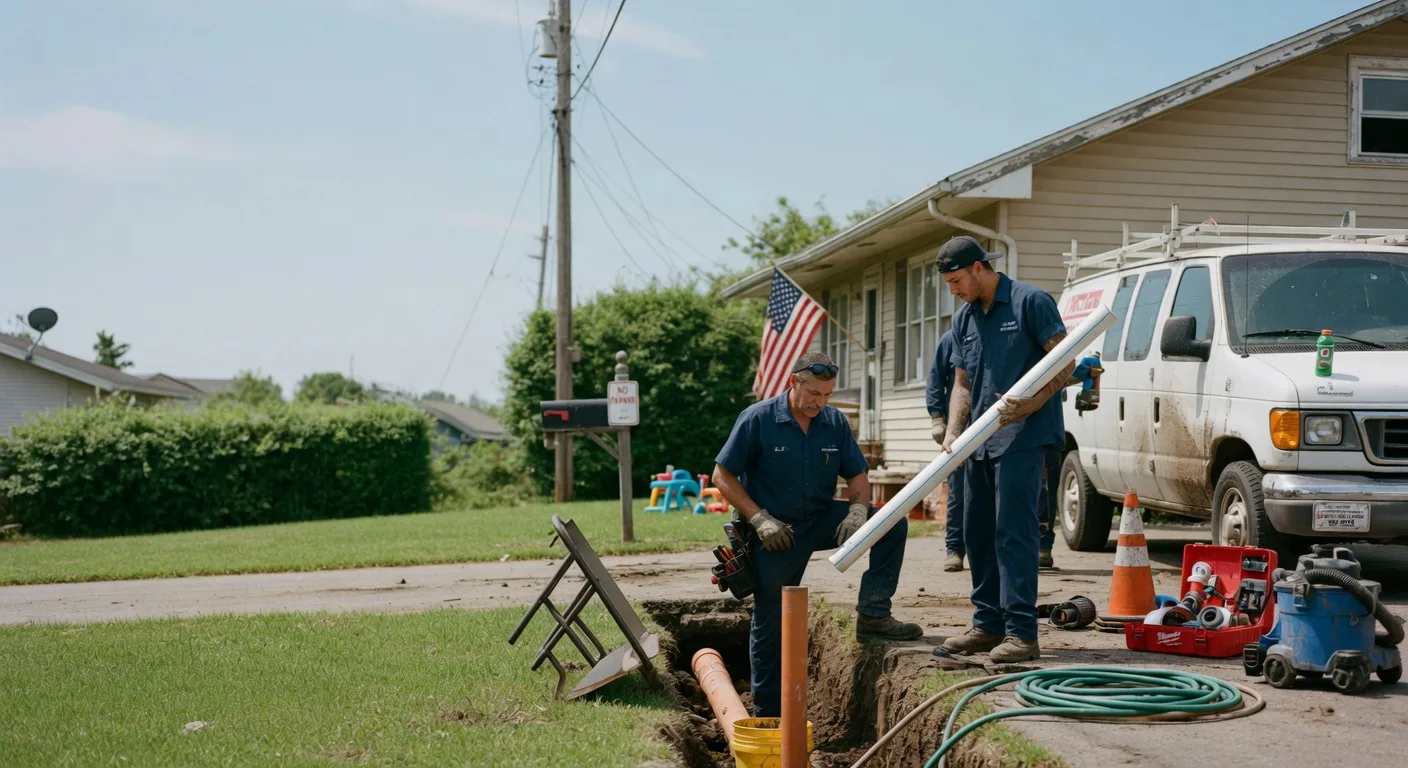
A single sink, tub, or floor drain running slow in Los Angeles, CA usually means one localized clog, not a whole-house problem, and a cable machine can clear it.

Talk to a pro
03 / 06

Main Line Cleaning

Every drain in the house backing up at once in Los Angeles, CA points to the main line, not one fixture, and needs a larger cable or jetting.

Talk to a pro
05 / 06

Sewer Line Inspection

Recurring backups or slow drains across Los Angeles, CA with no clear cause? A camera inspection finds the actual break, root, or bellied section first.

Talk to a pro
06 / 06

Sewer Line Repair

Multiple drains backing up at once in Los Angeles, CA, water pooling around a cleanout, or sewage odor in the yard usually points to a damaged sewer line, not a single clog.

Talk to a pro

About Expert Plumbers Co

Drain Cleaning and Plumbing Company in Los Angeles, CA

Los Angeles drain trouble usually starts at the lateral, the pipe that carries everything from the house to the sewer main in the street. In older parts of the city that pipe is often vitrified clay, laid in short sections with a joint every few feet. Mature parkway trees find those joints, push in fine roots, and the roots snag paper and grease. The line drains slowly for months, then stops.

Storm drains and sanitary sewers are separate systems here, so a winter downpour is rarely the culprit. Roots, grease, scale and sags are. Tap water also runs hard across the city, harder in the east and the harbor area than in the Valley and on the Westside, and that hardness builds scale inside old cast iron stacks.

  • Highland Park (90042) and Eagle Rock (90041): older bungalows and craftsman houses, many on raised foundations. Original cast iron stacks inside the walls narrow from the inside, and the clay lateral runs under front yards full of established roots.
  • Silver Lake and Echo Park (90026): hillside lots where the line has to drop quickly to the street. A settled section can hold water and collect debris.
  • Sherman Oaks (91403), Van Nuys (91401) and Sun Valley (91352): post-war houses in the San Fernando Valley, many on concrete slabs. The drain runs under the floor, so a failed section can mean opening the slab. Some lines from this era were laid in Orangeburg, a tar and fiber pipe that flattens and sags with age.
  • Boyle Heights (90033) and Leimert Park (90008): older duplexes and small multi-unit buildings, where one lateral often serves several kitchens and the grease from all of them lands in one pipe.

The pattern across the city is the same. The older the line, the more likely a camera will show roots at a joint, a belly holding water, or scale where the pipe has narrowed.

01

Symptom-first

One slow fixture is a different job from every drain in the house backing up.

02

Independent

Pricing and on-site work are set by the local provider, not by us.

03

Local

Partners serve the city you called from.

04

Whole-system

Fixture drains, branch lines, main line and sewer lateral.

Why choose us for Drain Cleaning

Los Angeles, CA Plumbers for Drain Cleaning

What it looks like. One slow sink is a local clog, usually hair or grease in the trap or the branch line. The tub filling when the washer drains, or a toilet gurgling when you run the shower, means the shared line is restricted. Sewage at the lowest drain in the house, or water standing at the cleanout, means the lateral itself is blocked.

Safe homeowner checks. Plunge a single fixture once or twice. Find the cleanout cap near the front of the house and see whether it is wet. Notice whether other drains react when you run water. Do not pour caustic cleaner into a line that may be full of standing water. It sits there and burns whoever opens the pipe next.

Stop and call now. If more than one fixture is backing up, if sewage is surfacing, or if the lowest fixture in the house sits below the street, stop running water. Every flush and every load of laundry adds to what is already trying to come back up.

Cable, jet or camera. A cable machine opens a path through a soft clog or a thin root mass, and it is the right tool for a single branch line. When roots are thick at a clay joint, when grease has coated the pipe wall, or when scale has narrowed cast iron, a cable only punches a hole and the line closes again. Hydro jetting scours the wall. A camera inspection shows whether the cause is roots, a belly, an offset joint or a collapse, and that decides whether cleaning is enough or repair is on the table.

What drives the cost. Access comes first. A cleanout in the yard is a simple setup. A line under a slab or beneath a hillside patio is not. Then the pipe itself: a spot repair, a trenchless liner or a full replacement, and how much has to be opened up and restored. Permits matter as well. In Los Angeles the owner is generally responsible for the lateral, including the part running under the street, and work in the public right of way needs a separate city permit. A backwater valve needs a Department of Building and Safety permit. Your plumber works out which apply.

Expert Plumbers Co is a referral service. We do not employ plumbers or set their schedules or prices. Tell us what the drains are doing and we connect you with an independent plumber in Los Angeles. Call (380) 262-9173.
  • Independent local partners
  • 24/7 emergency phone line
  • No obligation
  • Nationwide coverage
  • Symptom-first matching
  • Nights and weekends
Call (380) 262-9173
Why choose Drain Cleaning in Los Angeles, CA

How it works

Four simple steps to Drain Cleaning in Los Angeles, CA

01

Tell us the symptom

Tell us what the drain is doing and where you are.

02

Matched to the job

We match the problem to a plumber who has the right equipment for it.

03

They contact you

They contact you directly to arrange the visit.

04

If it is not right

If they cannot help, tell us and we find another.

Coverage

Drain Cleaning Services Across Los Angeles, CA

Covering Los Angeles, CA and nearby ZIPs.

Los Angeles · Los Angeles is known for the entertainment industry, beaches, and diverse urban culture. · Mediterranean climate with mild winters and warm dry summers.

Neighborhoods we cover for Drain Cleaning

  • Downtown
  • Hollywood
  • Venice
  • Santa Monica
  • Westwood
  • Koreatown
  • Silver Lake
  • Echo Park
  • Boyle Heights
  • East Los Angeles
  • South Central
  • Watts

Local landmarks

  • Hollywood Sign
  • Griffith Observatory
  • Los Angeles City Hall
  • Santa Monica Pier
  • Getty Center
  • Dodger Stadium
  • Universal Studios

ZIP codes we serve

90001 90002 90003 90004 90005 90006 90007 90008 90010 90011 90012 90013 90014 90015 90016 90017 90018 90019 90020 90021 90022 90023 90024 90025 90026 90027 90028 90029 90031 90032 90033 90034 90035 90036 90037 90038 90039 90040 90041 90042 90043 90044 90045 90046 90047 90048 90049 90052 90056 90057 90058 90059 90061 90062 90063 90064 90065 90066 90067 90068 90071 90073 90077 90079 90089 90095
Drain Cleaning Los Angeles, CA FAQs

Drain Cleaning FAQs

Frequently asked questions about Drain Cleaning

Questions Los Angeles, CA homeowners and businesses ask most about Drain Cleaning, with straight answers.

Talk to a real person
Why is one drain slow when the rest of the house is fine?
A single slow drain, like a bathroom sink or shower, almost always means a local clog close to that fixture. In a bathroom it is usually hair and soap scum matted just past the opening. In a kitchen it is grease that has cooled and hardened on the pipe wall, with food particles caught in it. The blockage sits in that fixture's own branch line, so nothing else in the house feels it. This is a cable machine job, because the cable punches a channel through the clog and restores flow. A safe homeowner check is to pull visible hair from the drain opening, or to clear the P-trap under a sink. If every drain in the house is slow or backing up together, the blockage is downstream in the main line, and that is a different job with different equipment. Root intrusion at a clay joint, a bellied section holding water, scale narrowing old cast iron, or a partly collapsed pipe can all cause it. If water rises in a tub when you flush the toilet, or a floor drain bubbles when the washer runs, stop running water and call. A plumber in Los Angeles, CA can tell which situation you have from a few questions. Watch how the slow drain behaves over a few days, because the pattern tells you whether it is getting worse. A sink that drains a little slower each week is usually a clog that is still growing, and it is cheaper and easier to deal with early than after it stops completely. A drain that clears and then slows again within a day or two suggests buildup on the pipe wall rather than a single plug. A common mistake is pouring boiling water down a drain that has a plastic trap or plastic pipe, which can soften joints and loosen them. Another is pushing the clog further down with a stiff wire hanger, which can scratch the pipe or wedge debris deeper. If the slow fixture is the one closest to the main line, such as a ground floor tub, treat it more seriously, since it can be the first sign of trouble in the main.
What is a cleanout and why does the plumber keep asking if I have one?
A cleanout is a capped pipe fitting that gives a plumber direct access to the sewer line. It usually looks like a round plug, three or four inches across, sitting on a short stub of pipe. You will often find one in the basement near the main stack, in a crawlspace, along an outside wall or in the yard near the foundation. The plumber asks because it decides how the job is done. With a cleanout, a cable machine or hydro jetter goes straight into the line. Without one, the equipment has to go in through a toilet, a floor drain or the roof vent. That can mean pulling a toilet, and it limits how far the machine travels and how well a camera can see. Safe homeowner check: find the cap and note where it is. Do not unscrew it if the house drains are backed up. Water can be standing behind the cap, and it will come out. Stop running water and call now if the cleanout is wet or leaking, or if several drains in the house are backing up together. That points to a blockage in the main line. If your home has no cleanout, adding one is often part of the job. What it costs depends on access, how deep the line is, how much has to be dug or cut open, and whether a permit applies. Expert Plumbers Co is a referral service. Call (380) 262-9173 and we will connect you with a plumber serving Los Angeles, CA for Drain Cleaning. A few practical points help when a cleanout is involved. The cap can be stuck from years of rust or paint, and forcing it with a long wrench can crack the fitting, so leave a stubborn one to the plumber. Keep the area around it clear of storage, snow, soil or landscaping so the crew can reach it quickly. In older homes the cleanout may have been buried when the yard was regraded, or covered by a patio or flooring, and finding it can take some probing. Newer homes usually have one near the foundation or at the property line, sometimes with a green or black cap flush with the lawn. If a plumber can find or install one, later cleanings and camera inspections become simpler and less disruptive, because the equipment enters the line at a planned point and nothing indoors has to be disturbed or removed.
What causes scale build-up inside old cast iron drain pipes?
Scale in cast iron is rust and mineral deposit growing on the inside wall of the pipe. Cast iron corrodes from the inside over decades. The rust forms rough lumps, called tubercles, and minerals carried in the water settle on them. Grease, soap residue and paper then catch on that rough surface and the bore gets smaller. The homeowner sees it as drains that slow down over time, often more than one fixture at once, and gurgling when a tub or washer empties. The pipe can look fine from outside while the opening inside has shrunk to a fraction of its size. A cable machine will punch a hole through the scale, but the water often keeps running through a narrow channel and the build-up returns. Hydro jetting strips the wall back much more completely. Before either one, a camera inspection is worth having on old iron. It shows how much scale there is and whether the pipe wall is thin, cracked or flaking, because a line that is weak can fail once the scale holding it together is cleaned off. What the job costs depends on access, the pipe material involved, how much has to be opened up or removed, and any permit or code requirement. If sewage is backing up into the house, stop running water and call. Expert Plumbers Co is a referral service. We refer you to a local plumber for Drain Cleaning or Emergency Drain Cleaning in Los Angeles, CA: (380) 262-9173. A point many people miss is that cleaning scale is not always the end of the story. Once the wall is stripped back, the bare iron can start rusting again, so the line may need cleaning more than once over the years if the pipe is not replaced. Another sign it is getting worse is rusty or dark water standing in a drain that used to run clear, or small flakes of rust in a trap. In homes built before plastic pipe became common, a camera also shows whether the line is worth keeping or is near the end of its life. Pipes that are thin or cracked may need a section replaced, and that can be done in stages rather than all at once. When you call, mention the age of the house and any previous repairs to the drains, since patches in old iron often use different materials.
Sewage has backed up into my basement. What do I do right now?
Stop running water in the house now. That means toilets, sinks, showers, the washing machine and the dishwasher. Every gallon you send down the line has nowhere to go but out through the lowest opening, which is your basement floor drain. Stay out of the water. Keep children and pets away. If you must go in, wear boots and gloves, and do not touch outlets or appliances while standing in it. Do not pour chemical cleaners down any drain. One safe check: look at whether other drains upstairs are gurgling or slow. If they are, the main sewer lateral is blocked or failing. Typical causes are root intrusion at a clay joint, grease build-up on the pipe wall, a bellied line holding water, or a collapsed section. A single slow fixture is a branch line problem. A basement backing up with the whole house affected is a main line problem, and it needs different equipment. This is Emergency Drain Cleaning, and it is not a homeowner job. A cable machine at the cleanout can clear a soft blockage. Roots and grease usually need hydro jetting, and a camera inspection shows why the line stopped. Cost depends on cleanout access, what is found in the pipe, how much has to be removed or repaired, and any permit requirement. Expert Plumbers Co is a referral service. Call (380) 262-9173 and we will refer you to a plumber serving Los Angeles, CA. Once the water is stopped, take photos of the water line and the affected items before anything is moved, and write down the time you first noticed it. If the backup is sewage, do not use a wet vacuum or a household fan on it, and do not start throwing out porous items until the plumber has opened the line. Tell the plumber what ran just before the backup, such as a load of laundry or a long shower, and whether the floor drain or a basement toilet was the first place it showed. In an older home with a clay or cast iron lateral, the cause is often roots or a collapsed section. In a newer home it is more often a belly, a joint that was set poorly, or a heavy wipe or grease blockage. After the line is cleared, the floor and walls still need proper cleaning and drying, and that is separate from the plumbing repair.
What does it mean if the cable machine stops at the same distance every time?
The cable stops dead at the same spot every time, and the plumber says it feels like a wall. That tells you the problem is fixed in one place. It is not a soft blockage that moves. Common causes are tree roots that have grown in at a clay pipe joint, a section that has dropped or cracked, or a bellied line where the pipe sags and holds water. It can also be a bad coupling where one pipe no longer lines up with the next. A cable can punch through roots or grease, but it cannot get past a pipe that has shifted or broken. Note the distance the cable went in. That number tells the next plumber where to look, and whether the fault is inside the house or out in the yard. Safe homeowner check: if only one fixture is slow, go easy on water and note which drain it is. Stop running water and call now if several drains back up, if water comes up in a tub or floor drain, or if there is a sewage smell indoors. A camera inspection is the right next step, because it shows what the cable hit. Roots or heavy grease may clear with hydro jetting. A broken or bellied pipe is a repair, and the cost depends on access, how much has to be dug or opened, the materials, and any permit required. Expert Plumbers Co is a referral service. Call (380) 262-9173 and we will connect you with a plumber in Los Angeles, CA for Drain Cleaning. Mark the spot where the stoppage sits if the cleanout or access point makes that possible, and tell the plumber whether the line runs under a slab, a driveway or a lawn. That decides how the repair is approached and how much has to be opened up. In older homes, the stoppage is often a clay joint that has been invaded by roots or has slipped, and the fix may be a spot repair on one section instead of replacing the whole run. In newer homes a stop at the same distance is more often a poorly set joint or a fitting that was installed out of line. After the camera has found the fault, ask for the footage or a few stills. They show the pipe material, the condition on either side of the problem and whether other weak points are coming. Until the repair is done, expect the line to clog again, so keep water use low and avoid putting anything but waste and paper into it.

Talk to a local Plumber

Need a plumber in Los Angeles, CA for Drain Cleaning? Call now.

Describe the problem and we connect you with a local Plumber for Drain Cleaning or Emergency Drain Cleaning. Call (380) 262-9173.

Call (380) 262-9173 Services